

Did you know that the concept of a nationally-adopted K-12 learning system originated in the United States? Broken down, K represents Kindergarten and 12 represents the 12 years of primary and high school education that follow.
As a parent or educator, you would have noticed that while schools adopt different curricula (National, British, American or Canadian), most educational systems have the K-12 learning system in common.
Origin of K-12 Education
Before K-12 became a recognised learning system in the West, good formal education was a luxury. Families hired private tutors and governesses for the first few years of homeschooling before sending their teenage boys off to boarding schools and the girls to finishing schools.
By the 1830s, Horace Mann began to lay the foundation for what would become K-12 education in the United States through his ‘Common School Movement’. He advocated for public schools that would be universally available, free of charge and state-funded. Through the 20th century (1900s), K-12 evolved from locally run schools into a federally adopted and formally supervised system in the United States, spreading to other countries in the West, as well as colonies in Africa and Asia.
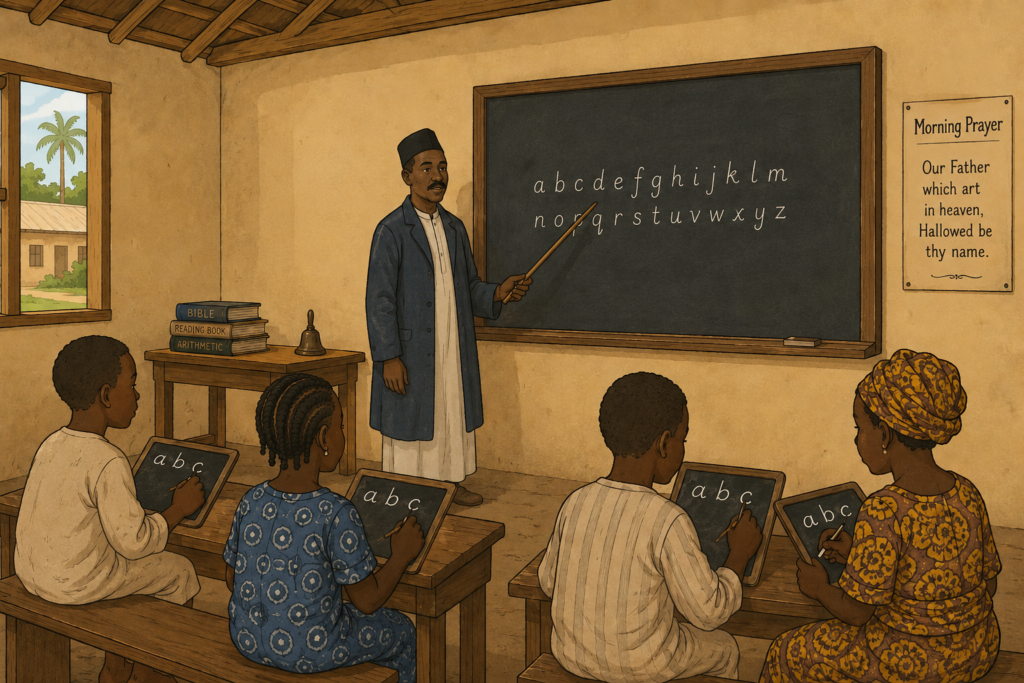
In West Africa, formal Western-style education rippled into society through colonial administration and Christian missionaries. While missionaries began establishing elementary schools, seminaries and eventually secondary schools between 1820 and 1900, colonial administrations made little contribution to education until critical reports were published between 1922 and 1925. (Britannica, 2026)
Although each country had individualised learning systems, it mostly comprised elementary education, varying secondary education (4-6 years) and then technical and professional schools. In 1951, the Anglophone colonial governments of Nigeria, Gold Coast (Ghana), Sierra Leone and The Gambia reached a significant milestone. They established the West African Examinations Council (WAEC) as a regional examination infrastructure, which exists till today; Liberia joined the coalition in 1974.
Like other African countries today, Nigeria and Ghana currently run distinct education structures, aligned with the spirit of K-12 but adapted to local contexts.
Modern Teaching (Pedagogical) Approaches to K-12 Ed
While the class and grade systems may vary per country, the K-12 system is designed to be heavily learner-centred instead of instructor-led, advancing learners from ignorance to mastery. Here are research-proven pedagogical approaches that teachers across the world use to achieve that:
1. Project-Based Learning (PBL)
While traditional instruction emphasises knowledge transfer from the expert (teacher) to the student, often in a lecture format, project-based learning uses a different approach. Here, students learn by engaging in personally meaningful and real-world projects. They are grouped into teams to investigate complex questions or solve problems in their immediate environment over an extended period.

For instance, Year 11 students learning about the history of Nigeria’s democracy may be tasked with proposing solutions to the question, ‘What can revive Nigeria’s failing democracy?’ while simulating a mock parliament. This project requires them to investigate Nigeria’s democratic history and propose solutions, bringing abstract democratic concepts to life. It also engages all students, fostering creativity, critical thinking and collaborative skills.
Numerous experts and two gold-standard studies have found significant academic improvement in students who were taught using project-based learning rather than traditional instruction.
2. Inquiry-Based Learning (IBL)
IBL leverages students’ natural curiosity, allowing them to discover new information and experiences on their own, just like scientists do. Here, teachers move from ‘telling things’ through these four phases:
- Orientation: provide background/big picture information and spark interest
- Conceptualisation: students narrow their focus, form research questions and hypotheses/predictions
- Investigation: students research, gather evidence and analyse information to get answers
- Conclusion: students summarise and communicate their understanding, reflecting on the entire process
With IBL, the K-12 teacher becomes an expert at listening to how a student is thinking, then asking high-order questions that ‘un-stick’ the student’s thinking, setting them off in the right direction.
3. Differentiated Instruction
Teaching everyone the same way loses the students at both ends: those who are ahead are bored, those who are behind are lost, and the teacher cannot reach everyone. However, differentiation optimises learning for every child regardless of their different backgrounds, prior knowledge and learning styles.
Teachers can differentiate:
| Content | Process | Product |
| presenting information in different formats like video, audio or text | designing different activities for students to master the same concepts | students demonstrate what they have learnt in different formats such as written reports, oral presentations, slides and so on |
Applying differentiated instruction also requires ongoing formative assessment, where students get feedback during the learning process, not after a final, end-of-term exam.
Other K-12 pedagogical approaches include cooperative learning, blended instruction, among others.
A Common Error in K-12 Education: Missing The Spiral Curriculum
Do you remember learning some topics in Year 3 and returning to them in Year 4 and 5 of elementary school? How about learning quadratic equations in Year 8 and going over them again in Years 10 and 11? For some of us, we most likely zoned out when the teacher started on a topic from the previous year.
Breaking news? The K-12 System is designed to build mastery through revisiting the same topics across different years. This concept is called the spiral curriculum. While it may look like repetition on a surface level, a closer look at the spiral curriculum shows that:
- The student revisits a topic, theme, or subject multiple times throughout their school career.
- The complexity of the topic increases with each revisit.
- New learning is contextualised within prior learning.
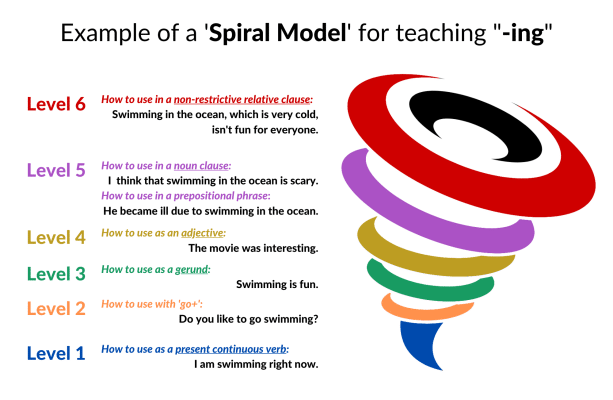
Rather than teaching every topic once and moving on, the spiral curriculum moves students from surface-level familiarity to a depth of understanding of the concept over time. A well-designed spiral curriculum moves learners across different levels of depth: a nursery pupil understanding fractions by physically dividing food, a primary school pupil working with diagrams as fractions, and a Year 8 student manipulating algebraic expressions.
This implies that students will learn the same concepts over and over again, but at different levels of mastery, in proportion to their age and developmental milestones.
However, a downside to revisiting topics is that some teachers over-reach while others under-teach the concepts. For instance, Mrs Jane’s Year 2 learners are struggling with main and helping verbs because their understanding of verbs has not been fully formed. Mrs Jane is overteaching the ‘verb’ curriculum at that level, rather than giving it the breadth and time her pupils require for mastery. On the other hand, Mr Musa neglects teaching his Year 5 students the distinction between main and helping verbs, so they struggle with phrasal verbs and verb clauses in Year 7.
It is the K-12 teacher’s duty to teach to mastery, following the curriculum guidelines. Rather than saying, ‘these students have done this last year, let me teach them something different,’ ask, ‘how can I determine that they reach/have mastery of this topic at their level?’ This perspective prepares learners for the next level of learning without overwhelming them now.

Key Principles for An Engaging K-12 Classroom
As you continue teaching or supervising young people in a K-12 or informal learning system, here are some expert-proven principles to adopt:
1. Assessment is not the end of learning; it is a part of it.
Give learners feedback on the go, so they can resolve difficulties or confusion early. Clarity can compound, so can confusion; consistent feedback is what differentiates both.
2. Engagement is not entertainment
Your goal is not to make learning more entertaining but to ensure every student is actively learning and engaged in effortful thinking. As you incorporate play and fun into learning, strike a healthy balance where the core topic doesn’t get lost in the class.
3. Classroom management is informed by structure
When students are genuinely engaged with meaningful tasks, behaviour problems reduce because the students have a compelling reason to be present. Structures such as clear routines, predictable transitions and explicit norms create ripe conditions for learning. Control attempts to force the same outcome and rarely produces it.
4. Build on prior knowledge
Do not teach into a void. Help your learners construct meaning by connecting new information to what they already know.
5. Invest in your own professional development
To maintain relevance as an educator, stay on top of new insights about your area of expertise, as well as general teaching principles. Consistent professional development is the mechanism by which good teaching stays good.
Which of these pedagogical approaches or principles have you tried in your school? What’s a new approach you’ll be implementing going forward? Let us know in the comments.

This is very insightful. Thank you for coming up with this article