
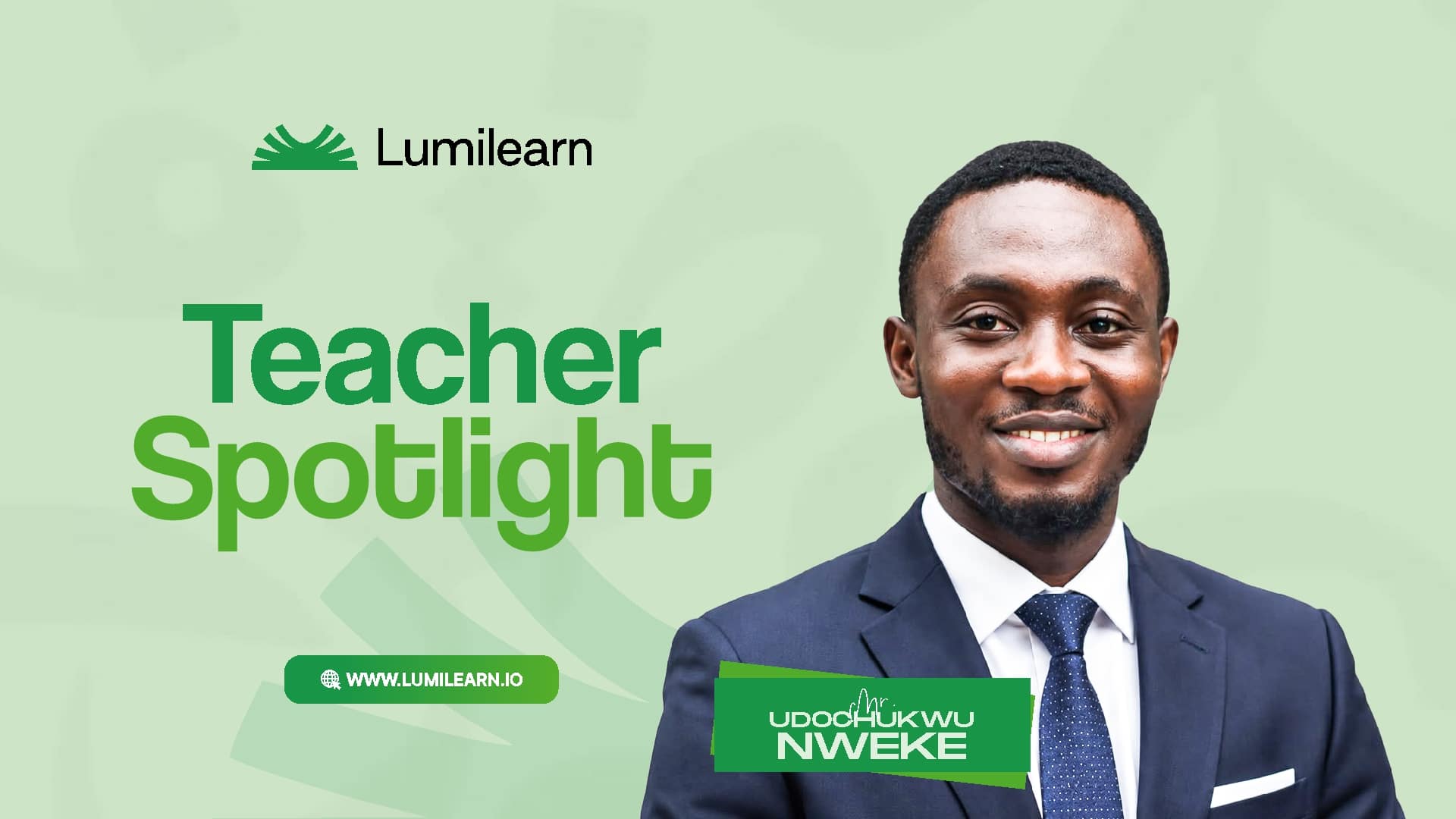
Some people find teaching. Others seem born for it.
For Mr Udochukwu Nweke, a Religion and National Values teacher at Debliz College, Ilorin, teaching was never a backup plan or something he stumbled into. Long before he stepped into a classroom professionally, he was already gathering younger children around the compound and using charcoal on walls as a makeshift blackboard.
Today, he teaches in school, teaches in church, researches, writes, and continues to learn every day. But beyond lesson notes and classroom routines, he carries a conviction that many people, including teachers themselves, need to hear.
“We have many teachers, but we lack teachers.”
In this Teacher Spotlight, Mr Udochukwu Nweke shares his journey, the realities of the profession, and why he still believes teaching remains one of the most important callings in the world.
The Charcoal Blackboard and a Calling
Unlike those who fell into the classroom by accident, Mr Udochukwu Nweke’s journey started in primary school. While other children played, he would gather his younger siblings and neighbourhood kids in their compound.
“We used the wall as our board and charcoal as our chalk,” he recalls. “From there, I’ve always enjoyed it. I always knew this was what I wanted.”
When he shared this with people, they looked at him strangely. Nobody just decides to be a teacher. But he had decided. Deliberately. Long before anyone gave him a classroom to stand in.
Yet, choosing the path of an educator in Nigeria rarely comes without resistance. When his mother found out he planned to make a career out of teaching, she adamantly opposed it. She wanted something different, perhaps something more traditionally lucrative. But Mr Nweke stayed the course anyway, driven by a quiet defiance.
“If you ask me what I would do even if nobody paid me, my answer has always been teaching,” he says.
The Empathy Lesson in Delta State
His first formal teaching experience came during an unusual time. In 2022, while still an undergraduate studying Sociology at the University of Ilorin, a massive eight-month ASUU strike shut down public universities across the country. Rather than sit idle, he travelled to Delta State to teach.
“It remains one of the most enjoyable work experiences I’ve ever had,” he says. “The students were welcoming and attentive.”
But what confirmed everything for him was one student who could not write. She struggled to relate to teachers and to her classmates. She was withdrawn. Mr Udochukwu Nweke Nweke, who teaches a subject built on empathy and human relationships, understood that reaching her meant going beyond the lesson.
He bought her writing practice books. He stayed close. He walked her through the basics with patience.
“I saw improvements,” he says. “She was realising herself. She was building self-esteem. That was when I knew. This is actually something I can do well.”
“We Have Many Teachers, But We Lack Teachers”
There is a line that Mr Udochukwu Nweke says that stops the conversation. “We have many teachers, but we lack teachers.”
He means it exactly as it sounds. He has watched people enter classrooms not because they love students or believe in the work, but because of the salary, the hours, or the title. The difference between those teachers and the ones who are truly present is immediately felt by students.
“Some people come because of the remuneration,” he says. “Some come because of the opportunities. Some come because of the extra time. And then they don’t pay attention to the students. It is not fair. I have witnessed it.”
He is careful not to frame this as mere judgment. Teachers are underpaid, overworked, and undersupported in Nigeria. He knows this better than most. At a previous school, the conditions were so bad, with no breaks and teachers shuttling between classes the entire day because the school simply did not have enough staff, that he reached a breaking point.
“They wanted to finish me in that school,” he says plainly. “The burnout was just too much. I told myself I would rather go home and join the family business than endure another term there.”
He pushed through until the end of the term. Then he left. And then a new opportunity came.
But his experience of institutional neglect has not made him cynical about teaching itself. It has made him more specific about what teaching actually requires.
“What we are doing is beyond the benefits and rewards that come from it,” he says. “Teachers themselves must understand that first.”
Teaching by Becoming
When you teach Religion and National Values, a subject that covers empathy, civic responsibility, social studies, and moral reasoning, you cannot teach it from a distance. You have to become it.
“Actions speak louder than words,” Mr Udochukwu Nweke says. “My students receive what I’m teaching when they see it in me.”
His style is practical and relational. He holds onto every topic he introduces and brings it back when real life offers a connection. Something happens in class, in the news, in the hallway, and he traces it back to a lesson from weeks earlier. He wants his students to see the relevance of what they are learning, not just retain it for an exam.
“I like to bring the topics into real life at all times,” he says. “So that students know the practicality of what they are learning.”
The Interview: A Conversation with Mr Udochukwu Nweke
Q: Outside the classroom, who are you?
Mr Udochukwu Nweke: I don’t know if I’m ever really outside teaching. If I’m not teaching in school, I’m teaching children in church. Teaching has always been part of my life. Apart from that, I do research, and I write. I’m a writer, so I spend a lot of time reading, researching, and working on stories. I also enjoy cooking and dancing.
Q: How would your students describe you?
Mr Nweke: The first thing they’ll say is that the uncle who likes smiling all the time. They see me as approachable and friendly. They always say I smile a lot. I think that matters. If students are afraid to come to you, you have already lost half the battle.
Q: If you weren’t teaching, what would you be doing?
Mr Nweke: Writing. I would probably spend my time writing stories. I have already written and published work, so that is something I genuinely enjoy. But honestly, teaching is my calling. It is the one thing I know I can do effortlessly, even if nobody is paying me for it.
Q: What is the hardest part of teaching that people don’t see?
Mr Nweke: Working with so many different human beings at once. I studied sociology, so I understand that people carry their experiences with them wherever they go. Students are young, and they haven’t yet developed the maturity to separate what happens at home from what is expected of them in class. So you will have a student who is distracted, disengaged, and underneath it is something that has nothing to do with your lesson. If it were just about entering the class, picking up a marker, and copying notes, teaching would be very easy. But trying to understand their mindset before you teach? That is the hard part. And it is the part many people never see.
Q: Have you ever felt tired of teaching?
Mr Nweke: Yes. At my previous school, the conditions were very difficult. Teachers weren’t well cared for, there weren’t enough staff members, and the workload was overwhelming. You could move from one class to another all day without even having enough time to sit down and rest. The burnout was intense. There was a point where I told myself it would be better to leave teaching entirely than continue in those conditions. But thankfully, things changed, and I moved to a better environment.
Q: What is one thing you wish more people understood about teachers?
Mr Nweke: I wish teachers themselves understood this more. Teaching is bigger than the rewards attached to it. I’m not saying teachers shouldn’t be paid well. They absolutely should. But I believe teaching cannot be driven primarily by money. Teachers have a responsibility to shape lives. We are examples to students. That is why I often say we have many teachers, but we lack teachers.
“Many people are in classrooms, but not everyone is truly committed to the students sitting in front of them.”
Some are focused only on the salary or the convenience. I think teachers need to continually remind themselves why they entered the profession in the first place.
Q: What would you say to someone who wants to start teaching but feels unsure?
Mr Nweke: You can never be truly ready. When I started, there were things I did that I would not dare repeat now because I have grown, and growth takes time. Go in as a work in progress. Go in prepared to learn every day. But if your fear is about money, about whether teachers are paid well enough, that motivation has to change. It will always disappoint you. The motivation has to be something more substantial. Maybe the belief that education is the best weapon through which you can change the world. If you have that belief, the fear becomes manageable.
Q: What is one mistake new teachers should avoid?
Mr Nweke: Never look down on students because of their academic performance. I made that mistake once. I had a student who wasn’t engaged in class and didn’t perform well academically. Because of that, I unconsciously expected less from him. And because he felt my low expectations, he actually did poorly. Later, I realised that was wrong. A student who isn’t performing is not a student you write off. They need you to believe in them more, not less. Always expect more from them. Let them feel that you do. Students often rise to the expectations placed on them.
Q: Why did you join Lumilearn?
Mr Nweke: I wanted to be part of a community of people who do what I do. Teaching requires continuous learning. Since joining Lumilearn, I have learned from the emails, resources, programmes, and conversations within the community. I didn’t study Education originally, so learning from experienced educators is valuable to me. I joined because teachers are learners too. It reminds me that I am not alone.
If His Journey Were a Movie
Q: What would the title be?
Mr Nweke: “Against All Odds.” When my mother found out I was planning to become a teacher, she was not happy. Not at all. People around me didn’t understand it. But I believed in it. I kept choosing it. And now they watch me, and they see that I genuinely love it. That is the film. Choosing something nobody expected you to choose, and then proving, slowly, that it was right all along.
Q: What is one classroom moment you wish had been recorded?
Mr Nweke: The moments when everyone is simply human. The moments when my students make me laugh. Those moments where I’m not acting as “the teacher” and they’re not acting as “the students.” We are just people sharing a moment. I try to ensure we have moments like that at least once a week. I experience them often, and they are some of my favourite memories.
Q: What would your students be surprised to learn about you?
Mr Udochukwu Nweke: They would be surprised to learn that I don’t know as much as they think I do. Students often assume teachers already know everything. They look at me in class and ask, “Uncle, how do you know all these things?” But the truth is, I sit down, I read, I teach myself, I understand it well enough to come and teach them. We study. We prepare. We wrestle with the material before we stand up and deliver it. I think they would be surprised, and maybe a little reassured, to know that.
Final Note
For Mr Udochukwu Nweke, teaching has never been about convenience, status, or even certainty.
It has been about impact. Whether helping a struggling student discover confidence, turning everyday classroom friction into life lessons, or reminding fellow educators why the profession matters, he carries a belief that shapes everything he does.
Teaching is not simply about standing in front of students. It is about caring enough to help them become better versions of themselves.
And perhaps that is exactly what he meant when he said, “We have many teachers, but we lack teachers.”
Mr Udochukwu Nweke teaches Religion and National Values at Debliz College, Ilorin. He is a published writer and a member of the Lumilearn teacher community.
Do you want to read another teacher’s story? Read about Abduljeleel Bello.